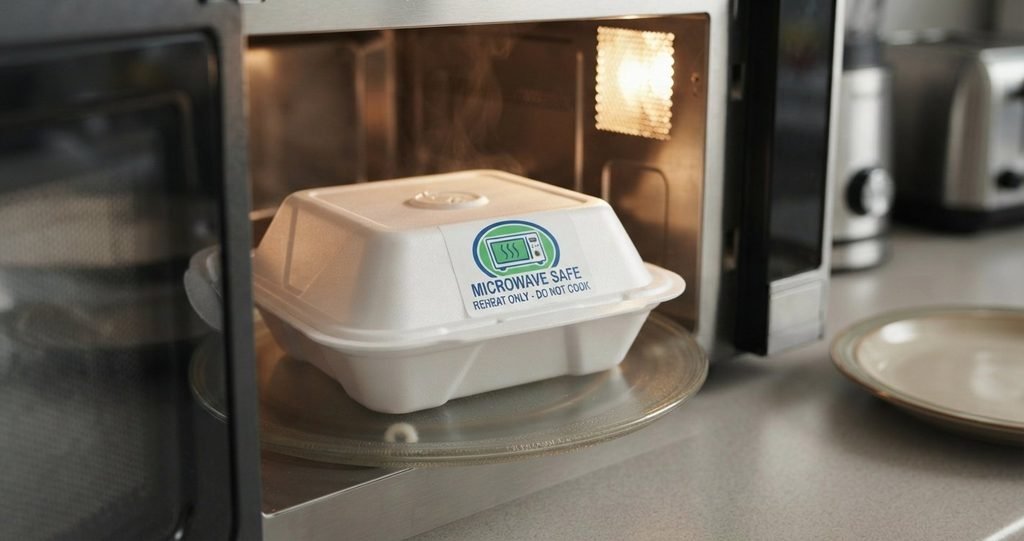
Only if the container is labeled microwave safe. Several sources agree that foam containers with that label have been approved for microwave use, while unlabeled ones should stay out of the microwave because their safety hasn’t been established. Even then, some sources advise caution and say glass or ceramic is the safer choice. When in doubt, move the food to a plate or bowl labeled for microwave use.
Read More: How to Poach an Egg in the Microwave: Safe, Easy Steps
First, What Is “Styrofoam”?
Healthline points out that Styrofoam is a trademark of The Dow Chemical Company for a polystyrene foam used mainly in building. In the US and Canada, people often use the word for expanded polystyrene takeout containers, cups, plates and packing peanuts. When people ask whether “Styrofoam” is microwave safe, they usually mean those foam containers, and that is what this article covers.
What the Microwave-Safe Label Means
Harvard Health explains the rule in plain terms:
- The FDA regulates containers that touch food.
- Manufacturers must test them, and the FDA reviews the data before approving microwave use.
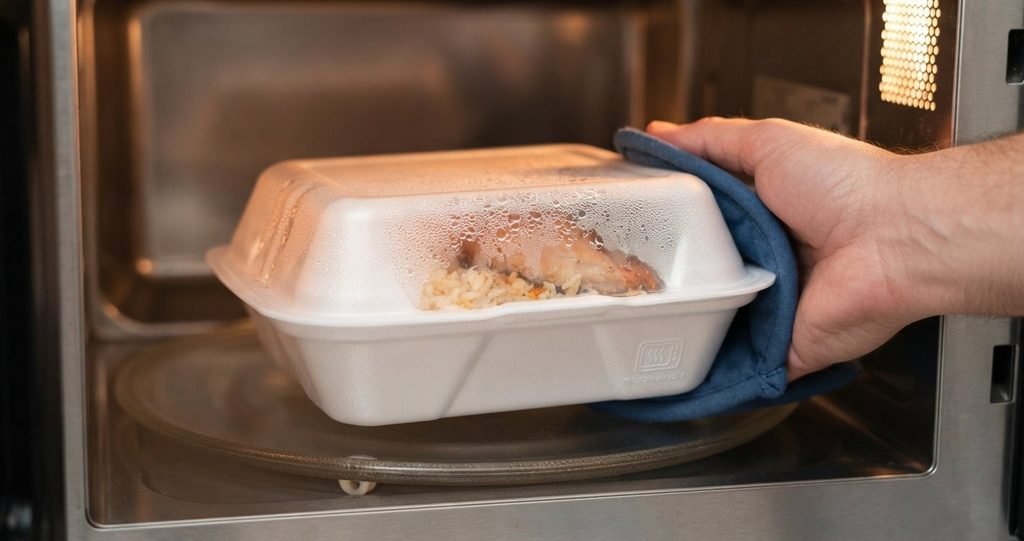
- Only approved containers can carry a “microwave safe” label or similar wording.
- Unlabeled containers aren’t necessarily unsafe. The FDA simply hasn’t determined their safety.
Harvard Health adds that some polystyrene containers are microwave safe, so check the label. The Takeout says containers with the wavy-lines microwave-safe symbol can go in the microwave, and that those without it are risky.
What this means: the label is the deciding factor. No label, no microwave.
Why Unlabeled Foam Is a Concern
Styrene
Foam polystyrene contains styrene. The Takeout, citing the National Toxicology Program’s 15th Report on Carcinogens, says styrene is “most likely a human carcinogen.” Healthline says styrene has been linked to cancer in animal and human studies. Heat can move styrene into food, particularly fatty foods such as meat and cheese, or when the container melts, according to The Takeout and Healthline.
The Takeout also notes that occasional exposure is likely not a major risk, but advises avoiding regular consumption of contaminated food.
Melting and mess
Sources describe melting as a risk for unlabeled foam. The Takeout says heating unlabeled containers can cause melting, release of harmful chemicals or fire. A Sharp (microwave maker) article says the container starts to melt above 212°F (100°C) and releases styrene gas, but gives no source for that figure, so I wouldn’t treat it as established.
Uneven heating
The Takeout notes that even microwave-labeled foam is a poor heat conductor, so food can stay cold in the middle while the outside warms.
Where the Sources Differ
| Source | Position |
| Healthline | Microwave only foam with a microwave-safe label; avoid unlabeled |
| Harvard Health | Some polystyrene is microwave safe; check the label; unlabeled isn’t automatically unsafe, just not confirmed |
| The Takeout | “Probably not.” Labeled foam can be microwaved, but glass or ceramic is safer and heats more evenly |
| Mr. Appliance (repair company) | Don’t microwave traditional Styrofoam; labeled microwave-safe foam is less common, only for reheating, and should be discarded if damaged or already microwaved once |
| Sharp (microwave maker) | Check the label and avoid containers without a clear indicator; move food to glass or ceramic if unsure |
What this means: all of these sources point the same way on unlabeled foam. The disagreement is about how comfortable to be with labeled foam, and the cautious route is to transfer food anyway.
When It Might Be Okay
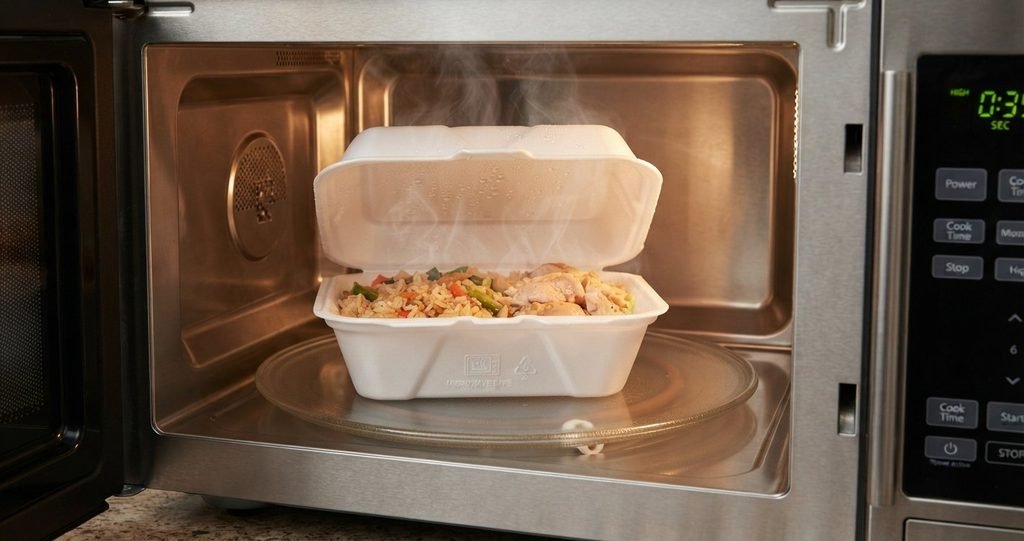
If a foam container or cup clearly says it is microwave safe:
- Use it for reheating only, not cooking (Mr. Appliance).
- Vent it by leaving the lid ajar or lifting an edge of the cover (Harvard Health, Healthline).
- Don’t reuse it after it has been microwaved once, and discard it if it is cracked, scratched, or damaged (Mr. Appliance, Harvard Health, Healthline).
- Take care with fatty foods, which may absorb more from containers (Harvard Health, Healthline).
What to Do Instead
Healthline, Harvard Health, and Sharp all recommend moving food into a microwave-safe glass or ceramic dish. Other options from the sources:
- Use a microwave-safe plate or bowl covered with a damp paper towel (Mr. Appliance).
- Heat on the stove in a covered skillet with a little water, or reheat soups and stews in a saucepan (Mr. Appliance).
- Use parchment paper, wax paper, white paper towels or a domed cover instead of letting plastic wrap touch food (Harvard Health).
Reheated food should reach at least 165°F internally and shouldn’t be reheated more than once (Mr. Appliance).
Common Styrofoam Items and What to Do
| Item | Guidance |
| Takeout clamshell with no label | Don’t microwave. Transfer food to a bowl or plate. |
| Foam cup (coffee, instant noodles) | Check for a microwave-safe mark. If none, pour into a mug. |
| Foam meat tray | Not a microwave-labeled container. Move the food to a dish. |
| Foam plate | Only if labeled; otherwise use a regular plate. |
| Packing peanuts or building foam | Not food containers. Never microwave. |
The cup and tray guidance is my application of the labeling rule above; the sources give the general rule, not item-by-item advice.
Environmental Note
Healthline and The Takeout note that foam doesn’t decompose easily and is hard to recycle, and that several US states and cities have banned it. The Takeout lists Maine, California, Oregon, and Delaware. This is separate from microwave safety, but it is another reason to move food into reusable dishes.
Frequently Asked Questions
Is Styrofoam microwave safe?
Only if it’s labeled microwave-safe. Unlabeled foam should not be microwaved.
Can I microwave a Styrofoam cup?
The same rule applies. Without a microwave-safe label, pour the contents into a mug.
Why is unlabeled Styrofoam a concern?
Heat can move styrene from the container into food, especially fatty food, and the container can melt. The FDA hasn’t determined that unlabeled foam is safe in the microwave.
Is styrene dangerous?
The Takeout, citing the National Toxicology Program, says styrene is most likely a human carcinogen and says occasional exposure is likely not a major risk. Avoid regular exposure.
Does the microwave-safe label guarantee safety?
It means the container was tested and approved for microwave use according to Harvard Health. The Takeout still recommends glass or ceramic because they heat more evenly.
Does Styrofoam melt in the microwave?
It can, especially if unlabeled or overheated. The Takeout lists melting as a risk, and Sharp gives 212°F (100°C) as a threshold, though it provides no source for that number.
What’s safer than Styrofoam in the microwave?
Glass or ceramic labeled for microwave use. Harvard Health also lists parchment paper and white paper towels as covers.
Is it safe to microwave a foam cup of instant noodles?
Only if the cup is labeled for it. The Takeout notes that Cup Noodles switched from foam to microwave-safe paper containers.
Conclusion
Styrofoam, or more accurately foam polystyrene, is microwave-safe only when the container is clearly labeled for microwave use. Without a label, its safety hasn’t been established, and styrene migration and melting are the main concerns. Even with a label, the cautious approach is to reheat only, vent the container, never reuse it, and consider moving the food to glass or ceramic anyway. If you can’t find a label, transfer the food. It takes a few seconds and removes the question entirely.