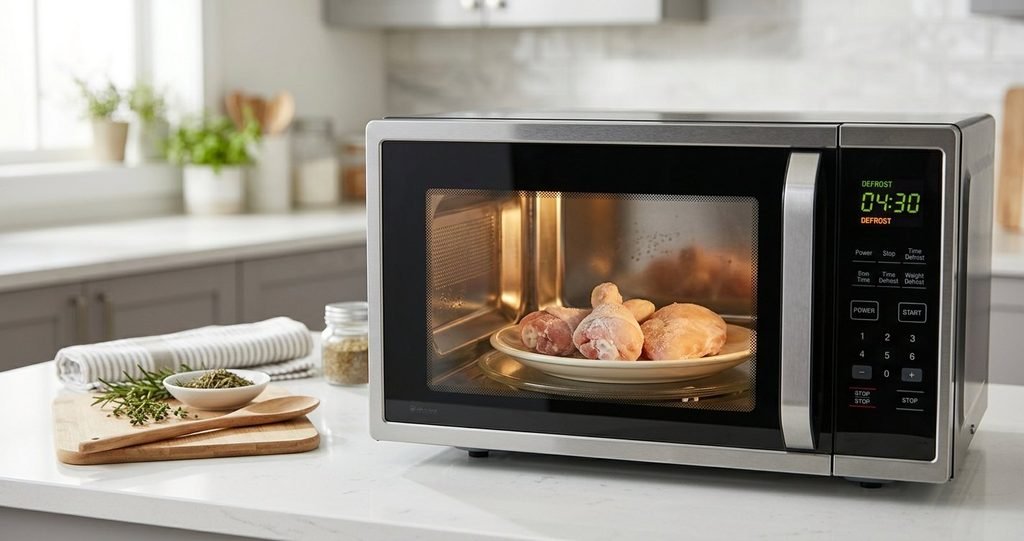
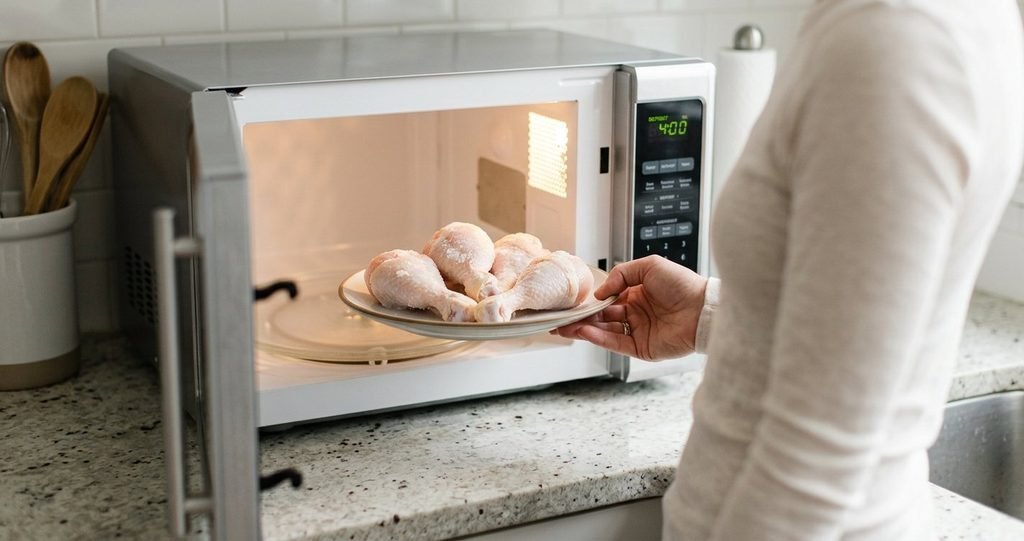
Take the chicken out of its packaging, put it in a microwave-safe dish, and use your microwave’s defrost setting (or about 20 to 30% power). Allow roughly 8 to 10 minutes per pound, pausing every few minutes to flip or rotate it. When it is soft with no ice crystals, cook it immediately. Microwaves heat unevenly, so parts of the chicken can warm into the danger zone, and cooking it right away is the safety rule that matters most.
Read More: Microwave & Oven Combo Reviews: 2026 Top Picks
Step-by-Step: Defrost Chicken in the Microwave
These steps combine guidance from two appliance makers, Maytag and KitchenAid, which give nearly identical instructions.
- Unwrap the chicken. Remove all packaging with clean hands and note the weight, or weigh it on a food scale.
- Use a microwave-safe dish. Glass or ceramic works best, according to Maytag. KitchenAid adds that zipper-top bags are only for use if the bag maker says they’re microwave safe.
- Choose the setting. Use the Defrost mode and enter the food type (poultry) and weight if your microwave has one. If not, use about 20 to 30% of maximum power.
- Start with the estimated time. Allow about 8 to 10 minutes per pound.
- Pause, then flip or rotate. Turn the chicken every few minutes so it thaws evenly. If your microwave has no turntable, rotate the dish by hand.
- Check it. Maytag says to cut a small sliver from the thickest part. The chicken is ready when it’s soft with no ice crystals.
- Cook it immediately. Don’t set it aside after defrosting.
How Long Does It Take?
KitchenAid’s approximate times at 20 to 30% power:
| Weight | Approximate time |
| 1 lb | 8 to 10 minutes |
| 2 lb | 16 to 20 minutes |
| 3 lb | 25 to 30 minutes |
Maytag says a 1.5 lb chicken breast takes roughly 12 to 15 minutes.
Other sources give different times. A Clemson extension factsheet says a pound of food can thaw in 7 to 8 minutes. A Serious Eats test reported by tester Christie Rotondo found times in a 1,200W microwave from about 5 minutes for wings to about 25 minutes for bone-in thighs, while boneless breasts took about 35 minutes in a lower-wattage (900W) microwave.
What this means: use 8 to 10 minutes per pound as a starting estimate, then check often. Cut, thickness, wattage, and your microwave’s defrost programme all change the time. KitchenAid recommends checking your owner’s manual.
The Safety Rule: Cook It Immediately
- Clemson says it is “crucial to cook the food immediately after thawing” because microwaves heat unevenly and parts of the food can reach the danger zone.
- Maytag says to cook right away to limit bacterial growth, and KitchenAid warns that microwave thawing can be uneven, with warm spots that can encourage bacterial growth.
- In the Serious Eats test, surface temperatures reached about 80°F during microwave thawing, which is inside the danger zone. A USDA food safety specialist told the tester this was not dangerous if the chicken is cooked right away.
If the chicken has already been sitting out: Maytag and KitchenAid both say that if it has been at room temperature for more than 20 minutes, use the refrigerator or a cold water bath instead of the microwave.
Microwave vs Other Thawing Methods
The Serious Eats tester compared methods across more than 55 pounds of chicken:
| Method | Time | Notes |
| Microwave | About 5 to 35 minutes depending on cut and wattage | Fastest, but meat was noticeably drier and thawing was uneven |
| Cold water (changed every 30 min) | 45 minutes to 2 hours | Best balance of speed and quality |
| Refrigerator | About 19 to 30 hours | Best cooked results and the safest, but slowest |
| Room temperature | 2 to 4 hours | Most hazardous, per USDA as cited by the tester |
Clemson’s guidance on the other safe methods: the refrigerator keeps food below 40°F, and cold water thawing needs leak-proof packaging, water at 70°F or less, a water change every 30 minutes, and about 20 to 60 minutes per pound.
What this means: the microwave is the right choice when you’re short of time and will cook right away. If you can plan, the refrigerator gives the best result.
What to Expect From Microwave-Thawed Chicken
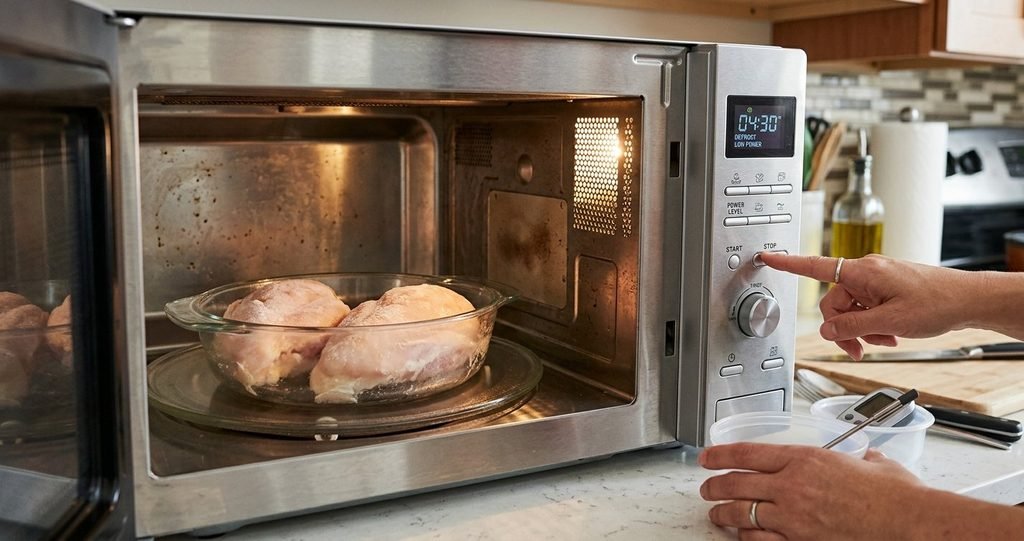
The Serious Eats tester did not recommend microwave thawing for quality. She found it “partially cooks the chicken and results in tough, dry meat.” Thin edges began to cook while centers stayed frozen: one drumstick’s thickest part measured 35°F while thinner parts near the bone hit 135°F. Fattier cuts such as bone-in thighs held up better.
This is one tester’s experience, but it matches the safety sources’ warning about uneven heating.
Tips for Better Results
- Use low power, not full power, as both manufacturers advise, to reduce the chance of the outside cooking before the center thaws.
- Pause and flip often, and rotate the dish if there’s no turntable.
- Thaw smaller portions. Clemson says the microwave suits smaller portions or food that will go into a larger dish.
- Separate pieces if you can, so thin parts don’t start to cook. This is my practical suggestion, not a source claim.
- Cook it in a way that suits partially warmed chicken, such as a stew, stir-fry or casserole, where slight edge cooking doesn’t matter. Clemson’s tip about food going into a larger dish points the same way.
- Check the thickest part, as Maytag advises, before cooking
Frequently Asked Questions
How do you defrost chicken in the microwave?
Unwrap it, place it in a microwave-safe dish, use the defrost setting or 20 to 30% power, flip it every few minutes, and cook it immediately.
Can I defrost chicken in a plastic bag?
KitchenAid says zipper-top bags are only fine if the bag maker says they’re microwave safe. The simpler option is a glass or ceramic dish.
How do I know when the chicken is defrosted?
Maytag says to cut a small sliver from the thickest part. It should be soft with no ice crystals.
Is microwave defrosting safe?
The Serious Eats tester says the USDA considers microwave thawing one of the safest rapid methods, provided the chicken is cooked immediately.
Will microwaving chicken make it dry?
It can. The Serious Eats tester found microwave-thawed chicken noticeably drier, especially lean cuts, while fattier cuts like bone-in thighs held up better.
What should I do if the chicken sat out after defrosting?
Maytag and KitchenAid advise that chicken left at room temperature for more than 20 minutes should be thawed in the refrigerator or in cold water instead.
Can I refreeze microwave-defrosted chicken?
The sources I reviewed don’t provide a specific rule for this. Clemson’s general guidance is that food should be fully cooked if it’s intended for refreezing, so cook it first.
Conclusion
To defrost chicken in the microwave, unwrap it, use the defrost setting or 20 to 30% power, and flip it every few minutes. Check the thickest part for soft meat with no ice crystals, and cook it immediately, since uneven heating is the main risk. Expect drier meat than you’d get from fridge or cold-water thawing, so use the microwave when you’re short on time, and plan for the best results.